Remote
User Testing
Playbook
This small part of a larger human centered design (HCD) process is a modern lean UX approach for conducting remote user research. These easy steps are an innovative framework to engage, document and analyze users and their experience with your software.

What Are Your Goals?
You can test anything with anybody. Identify what problems you are trying to solve. What are the enhancements or improvements you are trying to build? Be honest about your goals and share with everyone in the group. Their insights will amaze you and should help shape your path. Your users really want to help. It ultimately helps them.

Identify Your Users
Build a list of skill-diverse participants that are real users. A manageable number for small teams to be effective interviewing within a week is around 20.
Communicate With Your People
Reach out and speak to them. Email details of your request, goals, proposed meeting times. Get friendly. They need to let their guard down and feel comfortable in order to provide honest feedback. Make a spreadsheet, keep a schedule, send meeting invites. You want to interview them from their own environment using their own technology.

The Tools
You'll need a document for your script, a spreadsheet to track your users, email and meeting scheduling software, a phone, a voice recording mobile app, and software to make nice artifacts based on your research.
- Google Docs
- Google Sheets
- Outlook
- Skype/Webex/GoToMeeting/Phone
- Otter.ai (Voice Record/Transcribe)
- Adobe Creative Cloud


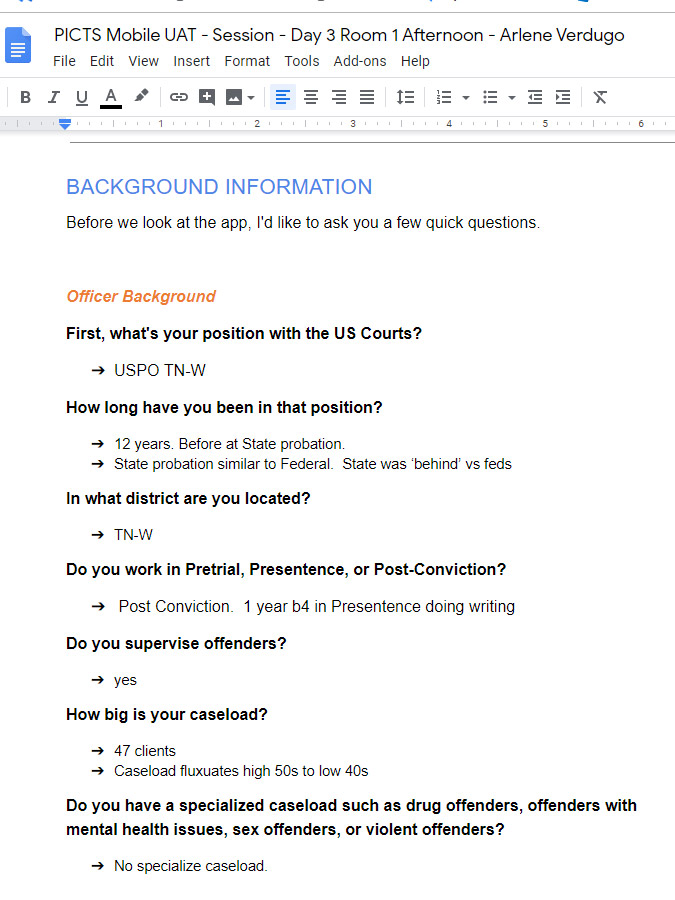
Interview
Call your users, record the sessions, take notes, and ask many questions.
Analyze
Brainstorm every session day. Take that feedback and run with it.

Get In Tune
In addition to gathering insight about the usage of our software, we want to know about the people, their processes, their daily routine.
Some of what we learned:
- Personal safety is the probation officer's first priority.
- Almost all officers now carry firearms, wear vests, and some are certified to use restraints.
- Officers have various physical work-arounds to accomplish technical software related tasks.
- They need full mobility for traveling to remote areas, offline capability, minimal battery usage.
- Most want a personal gov't vehicles instead of having to reserve G-cars. They want more freedom to be effective.
- Many officers rely on contact with their spouse/partner as a safety net. Ways to eleviate job stress on family should be a consideration.

Outcomes
Having a pre-determind set of deliverables is a good start and can inform your data collection process. After your data is consumed, a variety of artifacts can then be devloped from your research. A few we like are:
- User Journeys & Personas
- Human Centered Design Strategy
- Digital Information Strategy
- Design System & Component Library
- Product Design & Marketing Strategy
User Personas
A user persona, in human centered design, is created to represent a user type that might use technology, applications, websites, brands, or products in a similar way.

User Journeys
User journeys are a series of steps which represent a scenario for how a user might interact with the software we are designing.


More Coming Soon
Nice things in the works.